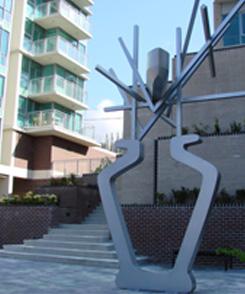


These coyotes are at home here, moving between the wild and the urban, quietly interwoven with our lives. They are bound to each other by an open and curious gaze, an implied conversation. They are dynamic, spiraling around each other, yet have a sense of stillness. The twinned forms explore reflection, pattern, symmetry, infinity, subtly playing with our perception. The coyotes rest on a vessel moving through space and time; beneath them concentric circles ripple outwards into the world. tête-à-tête suggests not only the physical journeys but also the interior journeys we each take - and the connections we make, one to the other.
Coyotes are spotted year-round in North Vancouver neighborhoods. They are intelligent, family-oriented, and highly adaptable. They live in green spaces near our neighborhoods, raising their young and communicating through vocalizations. Identifiable by their large, pointed ears, bushy tails, and yellow eyes, coyotes are active year-round.
They are most visible in late winter during mating season and in spring and summer when they teach their pups survival skills. On average, six pups are born each spring, though numbers vary based on food availability. In fall, young coyotes either leave to live independently or stay with their family. Many do not survive their first year, with vehicle collisions being a leading cause of death.
Though most active between dusk and dawn, urban coyotes often adapt to daytime activity to avoid humans. They play a crucial role in maintaining ecological balance. Coexisting with coyotes is possible by understanding their behavior, reducing food opportunities, and setting clear boundaries when encountering them.
(Source: North Shore Black Bear Society)
Materials: Bronze + Steel
Location: 128 15th St W, North Vancouver
About the Artists:
Jacqueline Metz and Nancy Chew are visual artists who started working collaboratively in 1997. Their backgrounds are varied: Nancy’s is drawing, painting, print-making, curating and teaching; Jacqueline’s is photography, archaeology and literature.
Their practice explores ideas of place and perception, landscape and culture.